Callanwolde Fine Arts Center 980 Briarcliff Rd Ne Atlanta Georgia 30306
| Callanwolde | |
| U.S. National Register of Historic Places | |
 | |
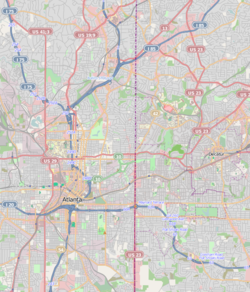
| Show map of Atlanta Show map of Georgia Prove map of the United States | |
| Location | 980 Briarcliff Rd., NE, Atlanta, Georgia |
|---|---|
| Surface area | xi.9 acres (iv.8 ha) |
| Built | 1917 |
| Architect | Henry Hornbostel |
| Architectural style | Late Gothic Revival |
| NRHP referenceNo. | 73002137[1] |
| Added to NRHP | Apr 23, 1973 |


Callanwolde Fine Arts Center is a 501(c)(three) non-turn a profit community arts center that offers classes and workshops for all ages in visual, literary and performing arts. Special performances, gallery exhibits, outreach programs and fundraising galas are presented throughout the yr. Callanwolde is besides involved in community outreach, specializing in senior wellness, special needs, veterans, and low income families.
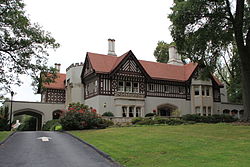
The mansion known as "Callanwolde" was built by Charles Howard Candler, President of The Coca-Cola Company (1916, 1920–1923), chairman of the Board of Trustees of Emory University (virtually thirty years), and eldest son of Asa Griggs Candler who founded The Coca-Cola Visitor. Callanwolde is a Gothic-Tudor style mansion situated on a landscaped 12.v-acre estate and is listed on the National Annals of Celebrated Places.
Support [edit]
Back up is provided to Callanwolde Fine Arts Heart through a grant appropriated by the DeKalb Canton Board of Commissioners, in part by DeKalb County Parks, Recreation & Cultural Diplomacy, and in part past the Georgia Council for the Arts through appropriations of the Georgia Full general Associates. Georgia Council for the Arts is a Partner Agency of the National Endowment for the Arts.
The Candler family [edit]
Callanwolde was the home of the family unit of Charles Howard Candler, known equally Howard, (1878-1957) from 1920 until 1959.
Howard Candler was the oldest son of Asa Griggs Candler (1851-1929), the Atlanta pharmacist who, in 1891 purchased the rights to the formula for Coca-Cola, which had been adult past some other Atlanta pharmacist, John S. Pemberton, in 1886 equally a tonic for most common ailments.
Howard Candler attended public elementary schools in Atlanta and received a Bachelor of Arts degree from Emory Higher (a Methodist Episcopal institution that was at that time located in Oxford, Georgia). While in Oxford in 1895, Howard Candler received a keg of Coca-Cola syrup from his father that he shared with his classmates — the starting time Coca-Cola ever seen there.
After graduating from Emory in 1898, Howard Candler attended Atlanta Higher of Physicians and Surgeons for two years and the Academy of Bellvue Infirmary Medical College for 1 year. Much later in life, in 1942, he received the Dr. of Laws degree from Emory Academy, which was by then located in Atlanta.
In 1903, Howard Candler married Flora Harper Glenn. The couple had 3 children, Charles Howard Jr. (born 1904), Catherine Harper (Mrs. William Warren) (born 1906), and Mary Louisa (Mrs. Alfred Eldridge) (built-in 1912).
The Candlers, Coca-Cola and Emory University [edit]
Emory Academy has been, and still is today, frequently called "Coca-Cola U" because of the long and generous history of patronage by both the Candler family and The Coca-Cola Company that they founded.
In 1914, the decision was made to move Emory Higher from Oxford, Georgia. Howard's uncle, Bishop Warren Akin Candler, was President of Emory College and the Chairman of the Methodist Episcopal Education Committee. Atlanta's Bedchamber of Commerce pledged $500,000 if the new Emory University would locate in the urban center, and in 1915 Asa Griggs Candler donated a $1 1000000 endowment to the establishment.
In 1915, Henry Hornbostel was engaged to design the new Emory campus in the Druid Hills neighborhood of Atlanta. The following year, Howard Candler, who had been a vice president of Coca-Cola since 1906, became the company's president, a position he held until his retirement from the company in 1923 (following its acquisition by the Woodruffs). His new position as caput of the company meant that Howard Candler would at present be the principal benefactor of Emory University. Piece of work on his new home, Callanwolde, was begun the following yr most the Emory campus and designed by Hornbostel.
In 1929, Howard Candler became chairman of the board of trustees of Emory University, a position he held until his decease in 1957. He connected the family's history of generous fiscal support of the institution as well. In 1947, for instance, he gave the university assets valued in excess of $15 1000000.
And, 2 years following Howard Candler's death, his widow donated the Callanwolde estate, forth with many of the original furnishings, to Emory University. Emory subsequently sold the property to the Commencement Christian Church, which retained ownership until the citizens of DeKalb Canton rallied to acquire Callanwolde in 1971.
Candler beginnings and the Callanwolde proper noun [edit]
Candler family lore holds that William Candler of Newcastle upon Tyne served as an officer in Cromwell's Regular army during the Irish Rebellion of the mid-17th century. Candler served in Sir Hardress Waller's Regiment and after the terminate of the entrada was elevated to the rank of Lieutenant Colonel for "meritorious conduct in the field" by a grateful Cromwell and Parliament and granted lands in the Barony of Callan, County Kilkenny. He brought his married woman, Anne Villiers, widow of Capt. John Villiers, and family unit over to Ireland and made their Irish home at Callan Castle. The proper name "Callanwolde" is based on this family unit connectedness to the Irish town of Callan and the Old English word for "woods" ("wolde").
Recent genealogical research suggests that parts of this legend are, in fact, true, although every bit happens with all things, some details have been lost, inverse, and exaggerated over the years.
The estate is located in the Druid Hills neighborhood of Atlanta, which was planned by the firm of Frederick Constabulary Olmsted, designer of Central Park in New York City and the Biltmore Estate in Asheville, NC. Of the manor's original 27 acres, approximately 12 remain intact. The grounds, which consist of sculptured lawns, formal gardens, nature trails and a rock garden, take been partially restored past the DeKalb County Federation of Garden Clubs and The Callanwolde Foundation, and are maintained by DeKalb County.
Designed by Henry Hornbostel, who likewise designed Emory University, Callanwolde's plan is 1 of openness. Nearly rooms adjoin the slap-up halls located on each floor, and the entire 27,000 square human foot mansion is centered on a large, courtyard that has recently been enclosed. The attention to fine detail is evident in the fantabulous adroitness of the walnut panelling, stained drinking glass, bronze balustrades, the artistry of the frail ceiling and fireplace reliefs, and the pierced tracery concealing the Aeolian organ chambers.
Callanwolde remained the Candlers' domicile for 39 years. In 1959, 2 years after Mr. Candler's death, and ix years prior to her own expiry, Mrs. Candler donated the estate (including many of the original effects) to Emory University.
The house (minus the furnishings) was subsequently acquired by the First Christian Church, which afterward sold two parcels of the property totalling approximately 4 acres on one side and approximately 12 acres on the other. The mansion was temporarily leased to an artist who planned to found an art gallery there. During this menstruum, the condition of the mansion deteriorated. Considerable damage was done to the organ pipes; careless apply of fire resulted in damage to the floor in one bedroom; and lighting fixtures, door and window latches, and other hardware were stolen. Eventually, the church placed the remaining 12 acres, which included the mansion, the carriage house, a gardener's cottage, two greenhouses, and various out-buildings, upwardly for sale.
To relieve Callanwolde from possible destruction, a fund-raising drive was led, first by an advertisement hoc committee of the Druid Hills Civic Association, and afterwards by The Callanwolde Foundation that formed from it. The property was purchased for $360,000 in 1972, with a matching funds grant from the open spaces plan of the Federal Housing and Urban Evolution Department. DeKalb Canton contributed $xl,000, accepted ownership of the holding and agreed to maintain it. Callanwolde was placed on the National Register of Historic Places and the Callanwolde Fine Arts Middle was opened under the supervision of the DeKalb Canton Recreation, Parks, and Cultural Affairs Department. In 1983, however, the non-profit Callanwolde Foundation accepted responsibleness for the functioning of the Callanwolde Fine Arts Eye, although DeKalb County continues to maintain the house and grounds.
Recent history [edit]
During the Summer Olympics held in Atlanta in 1996, the business firm was transformed into "Casa Italia," the official hospitality headquarters of the Italian Olympic Committee. Guests attention lavish parties hosted by the Italian delegation included Prince Albert of Monaco, Luciano Pavarotti, Andrew Young, Alberto Tomba, and a host of famous Italian fashion designers, chefs, Olympic athletes, artists and entertainers.
Callanwolde has also served equally a filming location for several Hollywood films, including "Sharkey'due south Machine," starring Burt Reynolds, and "Bear," a feature film near the life of legendary football motorbus Bear Bryant. In 2003, Callanwolde served equally the properties for several scenes used in the feature motion-picture show "Stroke of Genius, the Bobby Jones Story," starring Jim Caviezel.
Support to Callanwolde Fine Arts Heart is provided through a grant appropriated by the DeKalb County Board of Commissioners, in part by DeKalb County Parks, Recreation & Cultural Affairs, and in part by the Georgia Council for the Arts through appropriations of the Georgia General Assembly. Georgia Council for the Arts is a Partner Bureau of the National Endowment for the Arts.
Callanwolde is also mentioned in Pat Conroy's novel, "The Prince of Tides."
Architectural history [edit]
The mansion was built between 1917 and 1921 and is considered a severe and modern arroyo to the late Gothic Revival style of architecture.
The front facade of the two and one-half story building has medieval half-timbered rhythmical blueprint across the upper stories, crenellated trophy and Tudor arches, likewise as strapwork ornament, all the same all of these elements of Tudor-Gothic design have been subjected to a simplicity or severity of blueprint that is a uniquely 20th century arroyo to the use of these traditional design motifs.
The construction is of poured physical and steel and a rubble base of tile covered by stucco, and the business firm is built on a 2-human foot physical foundation.
All wooden floors are anchored to timbers laid in physical over masonry units supported past reinforced concrete beams. This quality of structure explains the fact that no settlement is discernable in the building. Downstairs floors are of walnut with walnut pegs, with the exception of the living room which has white oak flooring. Upstairs floors are of white oak. The house also features large rafters and panelling of walnut.
The house has a central heating system featuring recessed units behind decorative metallic screens. It was originally steam-heated, merely was converted from coal to gas heat in the 1930s. A vacuum system was congenital into the house, but it is no longer operable. In that location was also a buzzer system with a command panel in the kitchen, nevertheless it no longer exists. The pipes of the Aeolian organ are accommodated in the infrastructure of the house in four separate chambers.
Callanwolde's builder: Henry Hornbostel (1867-1961) [edit]
Callanwolde was designed past architect Henry Hornbostel of Pittsburgh. Hornbostel, born in Brooklyn, New York, was classically trained at Columbia University in New York City and the Ecole des Beaux Arts in Paris. He began work in Pittsburgh in 1904 afterwards winning the Carnegie Technical Schools Competition for the design of the campus that is now Carnegie Mellon University. He founded the Department of Architecture at Carnegie Tech, and, in addition to a private do in Pittsburgh, he taught at Columbia University and was at various times a partner in the New York firms of Howell, Stokes & Hornbostel; Woods, Palmer & Hornbostel; Palmer & Hornbostel; and Palmer, Hornbostel & Jones. Although the bulk of his practice centered in and around Pittsburgh, Hornbostel executed projects throughout the state, including the campus plans of Carnegie Tech in Pittsburgh, Emory University in Atlanta, and Northwestern University in Evanston, Illinois; several bridges in New York Urban center; and government buildings in Albany, NY and Oakland, CA.
One of the many enduring structures Henry Hornbstel designed was the Williamsburg Bridge (1903) in New York Metropolis. Connecting Manhattan to Brooklyn, and designed by Hornbostel and Leffert L. Buck, the 1,600 human foot bridge took over seven years to complete. When the bridge opened in 1903, it was the outset all-steel, large-scale suspension bridge congenital in the state –and the longest of its kind in the world. Information technology remained the earth's longest suspension span until the 1920s.
Hornbostel evidently met Howard Candler through a projection for The Coca-Cola Company. In 1915, he designed the main plan for Emory University when it was relocated to Atlanta from Oxford, Georgia.
Hornbostel's work, while cartoon heavily on historic precedents of Gothic, Tudor, and Renaissance styles, foreshadows the beginnings of a modernist sensibility in its stripped-down use of forms and relative absence of ornamentation. In this, information technology represents a transitional period between the bookish classicism and gothic revival of the 19th century and the modernist movement of the 20th century.
The Henry Hornbostel Collection is housed in the Architecture Archives of Carnegie Mellon University's Libraries.
Drawings, Plans and other information near the original design of the Emory Academy Campus are maintained by the University Library's Special Collections.
References [edit]
- ^ "National Register Information System". National Register of Historic Places. National Park Service. July 9, 2010.
External links [edit]
- Callanwolde Fine Arts Centre - official site
fournierpabis1940.blogspot.com
Source: https://en.wikipedia.org/wiki/Callanwolde_Fine_Arts_Center
0 Response to "Callanwolde Fine Arts Center 980 Briarcliff Rd Ne Atlanta Georgia 30306"
Post a Comment