draw 3d in onecnc mill 3d advantage
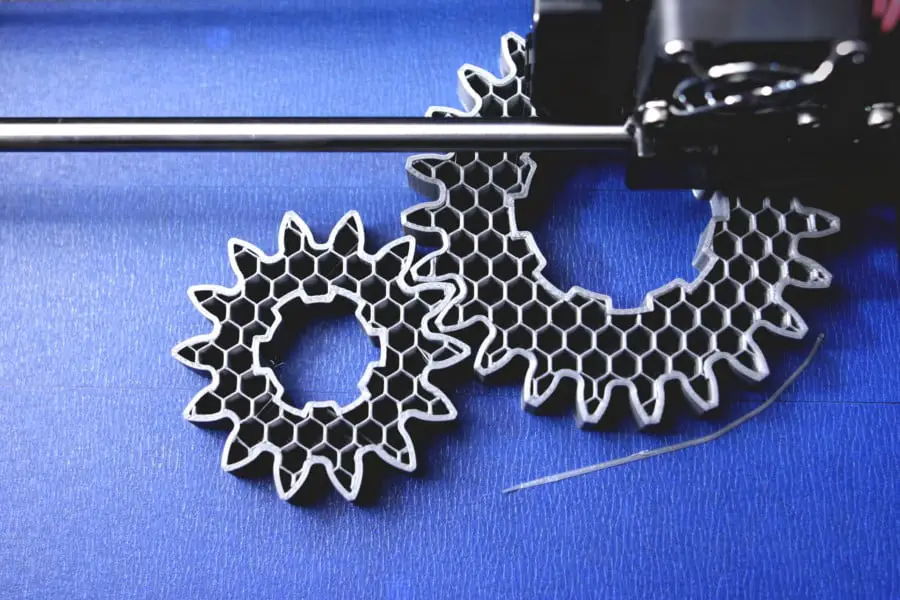
When I saw the dozens of possible infill patterns available throughout several slicers, I got very confused. Once I realized nonetheless that every pattern has a purpose, it was much easier to know which design to employ.
Whether the design's purpose is strength, flexibility, or simply to look good, infill is a very important part of your print. Once you know what you're print is going to be, yous need to know what pattern is right for your purpose.
Why do you demand infill?
If you're new to the world of 3D printing, y'all may exist wondering what infill is for. Infill provides the 3D print with internal support equally the printer builds each layer. Without infill, printing the summit layers would exist very difficult, as the plastic would sag over the empty parts of the print.
Besides the actual press process, infill will affect the forcefulness or feel of the final production. Once y'all know what your print is going to be used for, yous should take a general idea of the pattern and percentage that you want to use.
Infill Pattern Categories
For this article, I'g going to classify each infill pattern under i of five categories. Each of the categories has their ain use, and some of the infill patterns might even accept multiple categories.
Go on in heed that I'thou non an practiced, then all of these come from both personal testing and findings from other people'due south testing online. There are hundreds of different tests people have run on these patterns, and then I encourage you to do some testing on your own.
1. Low Force
Low force is for your standard models and trinkets. These are prints that won't run across any sort of functional use, and will probably sit on your shelf or desk.
These parts will probably employ a low infill percentage to save valuable time and money. Typically, low strength patterns too take the shortest amount of impress fourth dimension.
The focus of these prints will exist speed, which the low strength prints excel at doing. This type of pattern is also great for printer calibration prints since they take the shortest corporeality of fourth dimension.
2. Medium Strength
Medium strength infill is for parts that might encounter a piffling bit of use, or stuff you lot impress for other people. You could sell low strength parts to people, but then they won't be very durable.
If you utilise a medium strength pattern, the parts will generally be able to take a light beating before being totally destroyed. Dropping information technology on the floor is no problem, but heavy use will clothing them downward pretty quickly.
3. High Strength
These types of models are prints that volition meet heavy or functional use. These can include items with moving parts, clips, and hooks, drone bodies, or annihilation that needs to withstand moderate forcefulness.
Obviously, plastic filaments won't be every bit strong as metal ones, just they are a cheap alternative that tin can concluding quite a while depending on the apply.
High strength parts are typically printed with very high infill settings. The parts that need to exist extremely strong might even utilise 100% infill, and at that infill setting the pattern really doesn't matter anymore.
4. Flexibility
While PLA and ABS are fairly rigid plastics, TPU (flexible) filaments excel with these infill patterns. Usually, these infill patterns are the ones that don't take overlapping lines, such every bit the grid patterns.
Unless you are printing with TPU, you probably won't need to worry nearly these. Some of the flexible infill patterns do look amazing in time-lapses though.
In reality, you can probably print with whatsoever pattern for TPU, but some of them only feel better for flexibility than others.
v. Vanity
Vanity patterns have no purpose other than to wait good for the photographic camera. These patterns are by and large crazy shapes and lines that provide cypher for strength.
Some of these vanity prints can as well double as force prints, though. These prints have longer though, so they probably aren't worth it for the average print.
They besides have longer to print than other patterns, due to the crazy movements the printer has to brand on each layer. Unless you are doing a timelapse or you are just showing off some cool patterns to your friends, stick to the standard patterns.
Infill patterns of 3 slicers
Every slicer you use is going to have different infill patterns. Some are common throughout all slicers, but others accept some very unique patterns.
In this section, I'll give you a cursory overview of three slicers' infill patterns. In case you want even more information than that, I'll get into more than detail virtually some commonly used patterns after this section.
I also put some graphics together to prove you the different patterns each slicer has to offer.
Simplify3D
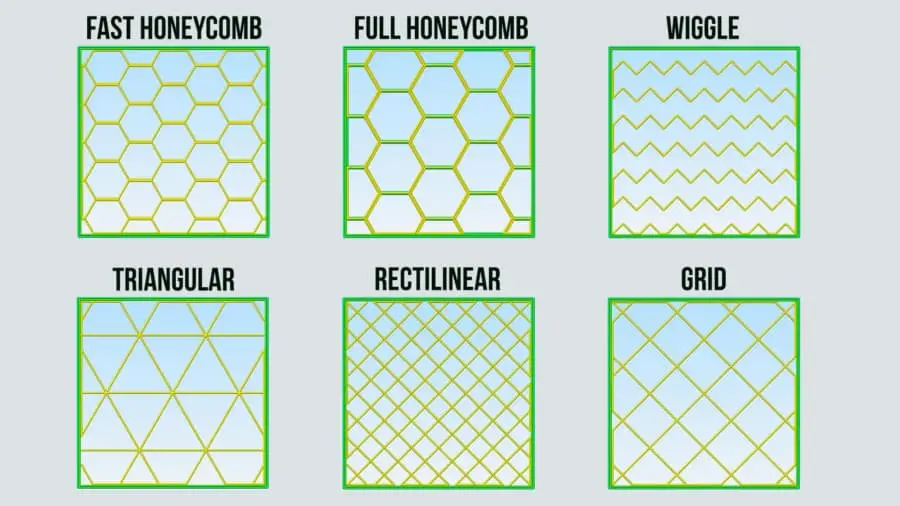
While Simplify3D has the least corporeality of infill patterns, it includes the patterns that you'll end upwards using the near. Personally, this is my favorite slicer, merely besides my least favorite when it comes to patterns.
For a paid program, information technology definitely needs to add many more patterns. It doesn't lack any other settings though. If y'all demand some cool looking patterns for fourth dimension-lapses, yous might want to check out the other slicers' patterns.
- Low Strength
- Jerk
- Medium Force
- Rectilinear
- Fast honeycomb
- Full honeycomb
- Loftier Strength
- Grid
- Triangular
- Flexibility
- Wiggle
- Vanity
- Wiggle
Cura
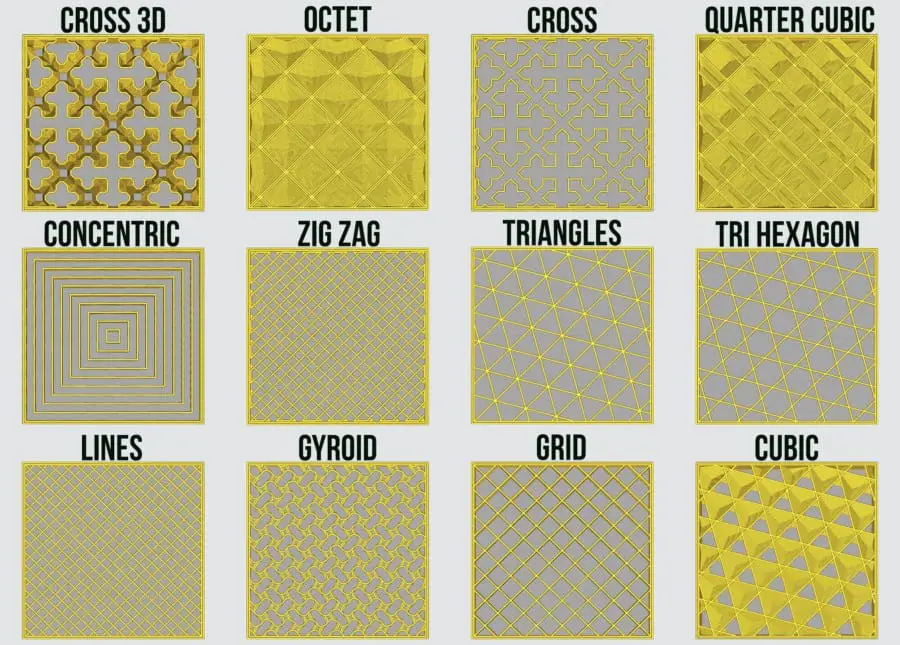
Cura is my 2nd favorite for infill patterns. It has the aforementioned amount that Slic3r does, but some are so like that you probably won't e'er use a lot of them.
It's a free program, and then you lot could use both this and Slic3r to experiment with a ton of new patterns.
Some of the patterns on this listing I learned from a great 3D press site called All3DP, which helped me learn a lot of new info near 3D printing.
- Low Strength
- Lines
- Medium Strength
- Octet
- Quarter Cubic
- Gyroid
- High Force
- Cubic
- Cubic Subdivision (not included in patterns image)
- Triangles
- Tri-Hexagon
- Grid
- Felixible
- Concentric
- Cross 3D
- Cross
- Lines
- Vanity
- Concentric
- Cantankerous 3D
- Gyroid
- Cubic Subdivision
- Cubic
- Octet
Slic3r
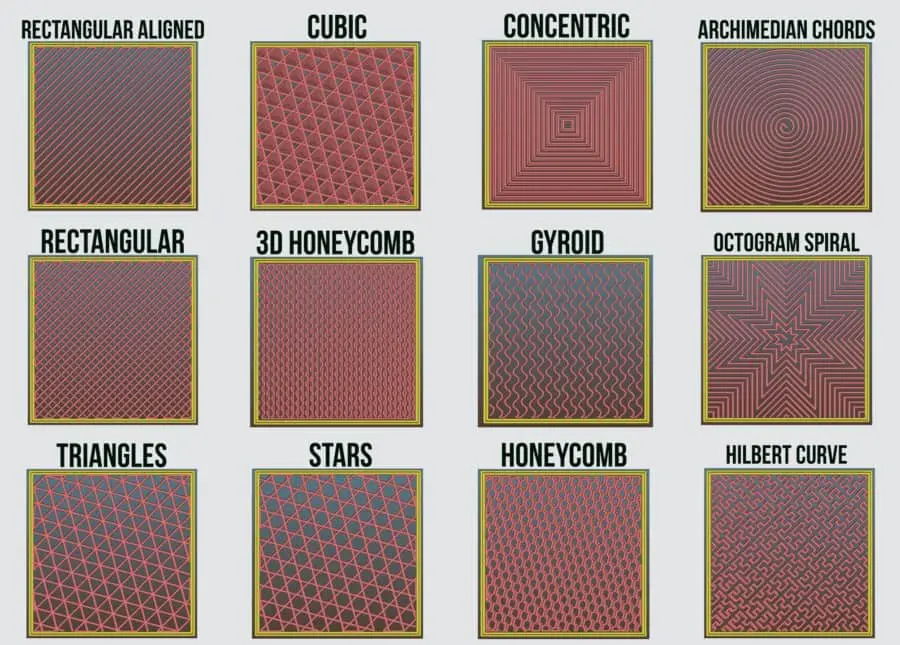
Slic3r isn't my favorite slicer, but information technology does past far have the best infill patterns. While a lot of them are vanity patterns, some of those patterns can also be used to strengthen prints every bit well.
Timelapses with some of these patterns look amazingly satisfying. The programme is free which makes it even meliorate.
- Low Strength
- Rectangular Aligned
- Medium Strength
- Honeycomb
- 3D Honeycomb
- Gyroid
- Grid (non included in patterns image)
- Archimedian Chords
- Octogram Screw
- High Force
- Cubic
- Rectangular
- Triangles
- Stars
- Felixible
- Concentric
- Cross 3D
- Cantankerous
- Vanity
- Concentric
- Cross 3D
- Gyroid
- Archimedian Chords
- Hilbert Chords
- Octogram Spiral
Infill Density
The density of your infill makes a huge divergence in the weight and durability of your impress. A low infill print will experience cheap and weak, while higher percentages feel heavier and strong.
When you print with flexible filaments, the amount of infill you use will make up one's mind how "squishy" the print feels. Higher infills with TPU will be more rigid.
If yous are press high-quality models for customers, you desire to use a higher infill density while using a faster blueprint. This allows it to print faster while still feeling heavy enough to not feel cheap.
Every bit presently as you know what the print will exist used for, yous can cull an infill pattern and density. Strength patterns will exist higher (sometimes fifty-fifty 100%).
For prints that yous will be using for display, attempt to print with every bit picayune of an infill percentage as possible. Joel the 3D Press Nerd made a great video near this topic.
External Fill Patterns
Another setting to watch out for is the external fill up pattern. What this setting does is affect the way the printer fills in the top layers.
Y'all can give your prints a cool finish by making your printer create some cool designs on the external top surface. For detailed models, you by and large should exit this at the default setting.
Simplify3D has only two options for external fill up patterns, but Slic3r has 5. Slic3r also allows you to change the top and lesser layer fill patterns separately, while Simplify3D changes both by default.
Other Infill Settings
Equally you've probably noticed in your slicer settings, there is another infill choice referred to as infill rotation.
What this feature does is rotate your infill to a sure degree every layer, causing the infill angle to change. This is useful for creating stronger prints, and also can look keen on a timelapse.
You can also choose to add a solid diaphragm every ten number of layers to provide extra strength. Combine infill is a setting that helps make your print even stronger and can help make sure the layers won't separate as easily.
My Favorite Infill Patterns
Jerk
This pattern consists of single wavy lines going from one side of the impress to the other. Information technology is the virtually popular Simplify3D design for both flexible prints and depression strength models for skillful reasons.
The first is that it prints much faster than any other infill patterns. For smaller prints, it won't matter much, but it'll make a huge deviation for the large ones.
The smallest amount of movement the print head has to do the meliorate. There is also less risk of a print failure when there are fewer movements on each layer.
The second is that it works great with flexible filaments. The parallel wavy lines plummet nicely, giving it a more than flexible feel. Information technology'south likewise a cool filament to use with time-lapses if yous use the infill rotation setting.
Honeycomb
Honeycomb infills just take a really cool look to them. Honestly, I don't see much of a difference between fast honeycomb and total honeycomb, likewise the obvious speed factor.
While it is zero special for TPU filament, the 3D honeycomb can too look actually cool for time-lapses.
Information technology may not exist the fastest infill pattern you tin can employ, only it's definitely one of the nearly fun. Sometimes I'll just stand and sentry my printer as it creates the perfect honeycomb shape in the interior of my print.
It is also a medium-strength infill (some people say it's loftier strength), so information technology provides some good strength, though it's not as strong as Triangular.
Gyroid
The Gyroid pattern has got to be one of the coolest you can apply. While not fast by whatsoever means, this spinning infill pattern is extremely fun to watch in time-lapses.
This fills a lot of area inside the model, making it less optimal for TPU. As a medium forcefulness filament, information technology tin be used quite readily throughout a ton of different types of prints.
Overall it'due south a very satisfying filament to use and doesn't get old very easily.
Triangular
The infill blueprint I probably use the almost is Triangular. These patterns are some of the best for loftier forcefulness prints while still printing at good speeds.
The triangle shape is just known to be extremely stiff geometrically, and it definitely shows in the print quality. Information technology's besides decent as a flexible pattern, as the triangles can compress nicely.
Information technology tin can get old fast using this in a timelapse, simply it's a great blueprint to use when you aren't sure which one to do.
Determination
Infill is a hugely important part of any print you'll practice, but you need to know the correct settings to use. When it comes to infill patterns, I recall Slic3r has the most artistic types. If you are into time-lapses or just desire really absurd looking patterns on your impress, y'all should use this slicer.
Cura is a close 2nd, merely some of its patterns are too similar. Simplify3D greatly lacks in this area, especially for a $150 price tag. I prefer this slicer for most prints, but I don't use information technology for the absurd blueprint effects.
At that place really aren't whatsoever major differences between any of these, as you lot could make your print succeed with all of them. It all comes down to a matter of preference and optimal print times.
fournierpabis1940.blogspot.com
Source: https://the3dbros.com/3d-print-infill-patterns-explained/
0 Response to "draw 3d in onecnc mill 3d advantage"
Post a Comment